 Login
Login 

We’re preparing for new waste sorting rules
We’re currently preparing for new legal requirements for waste management that will take effect on January 1, 2027. The goal of the new rules is to increase sorting and reduce residual waste. One key change is that food waste and residual waste must be sorted into separate bins going forward. To make this work, we need to update some of our recycling rooms and other waste solutions. In some areas, these changes have already started, but for most of you they will take place during the autumn.
Many of you have probably heard about the new four-compartment bins that house owners around Linköping have received this spring.
If you live in an apartment building, the solution will look a bit different.
Since Stångåstaden already has property-close waste collection (FNI), the changes won’t be very big for most of you. The main difference is that food waste and residual waste must now be sorted into separate bins.
Different types of solutions
What changes are made in your area depends on where you live and what waste system you have today.
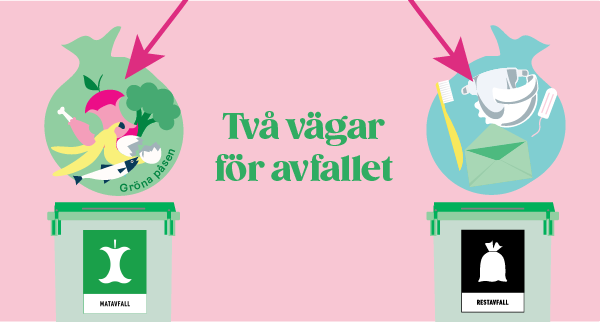
- In many areas, the only change is that we add new bins for food waste in recycling rooms. All food waste should be placed in the green bag (bags are available in your recycling room).
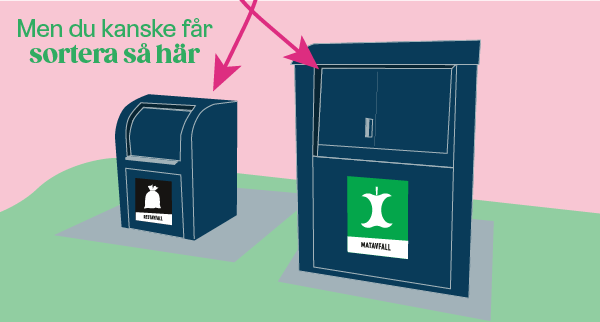
- Some vacuum waste systems can’t separate food and residual waste. These will need to be replaced with other solutions.
- For the same reason, some waste chutes in buildings will be closed or adjusted.
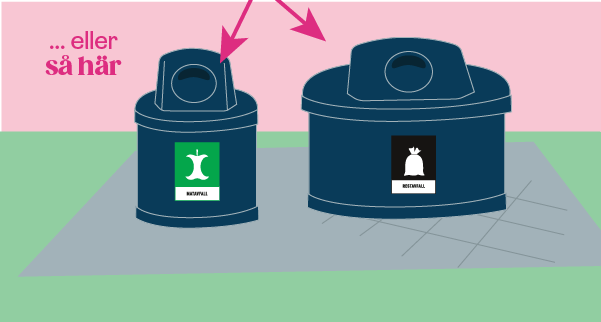
- In some areas, new waste containers will be installed, either above or below ground.
You’ll get exact information about what applies where you live via “My pages” and in your recycling room.
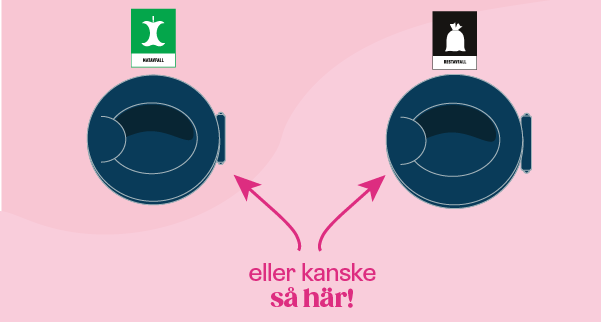
Test in Ryd with good results
This spring, five areas in Ryd tested the new system. Tekniska verken added new food waste bins, new signs were installed, and several information efforts were carried out.
Together with Tekniska verken, we’ve followed the results:
- The new sorting works well – most people sort food and residual waste correctly.
- 25% more food waste is sorted correctly instead of ending up in residual waste.
- Clear information makes a big difference – when more people know what applies, it’s easier to do the right thing.
We hope to see the same results as we roll this out across more areas during the year.
Läs mer på Tekniska verkens webb
During the year, waste handling will change so that food waste and residual waste are sorted separately. But what goes where?
Food waste → green bag
A simple rule: All food waste goes in the green bag – cooked food, raw food, fruit, vegetables, and leftovers from cooking. Tie the bag properly with a double knot.
When sorted correctly, food waste can be turned into biogas and biofertilizer instead of going to waste. All Tekniska verken garbage trucks run on biogas, and one bag of food waste can fuel about 3 km of driving.
Residual waste – what’s left
Residual waste is what can’t be recycled in any other way. So, what’s left after you’ve sorted out food waste, glass, metal, paper, and plastic packaging. Residual waste is used by Tekniska verken to produce district heating, cooling, and electricity. Some examples of residual waste: Paper towels and napkins, diapers, cacuum cleaner bags